January 18, 2011

Chipocrite - "Hit and Run"


GameBoy music newcomer Chipocrite has just released his debut EP, "Hit and Run", on BandCamp. Included in the standard edition are six fun, melodic LSDJ tracks, available on a pay-what-you-want basis. Chipocrite doesn't rely on standard GameBoy "UNCE UNCE" as much as he relies on creativity, which makes this EP worth a look-see. My personal favorite is "Mr. Knight Is in the Building", with its groovy bassline and strangely accurate title.

Stream/download the release here: http://cheesenbeer.bandcamp.com/album/hit-and-run-cnb-special-edition

January 13, 2011

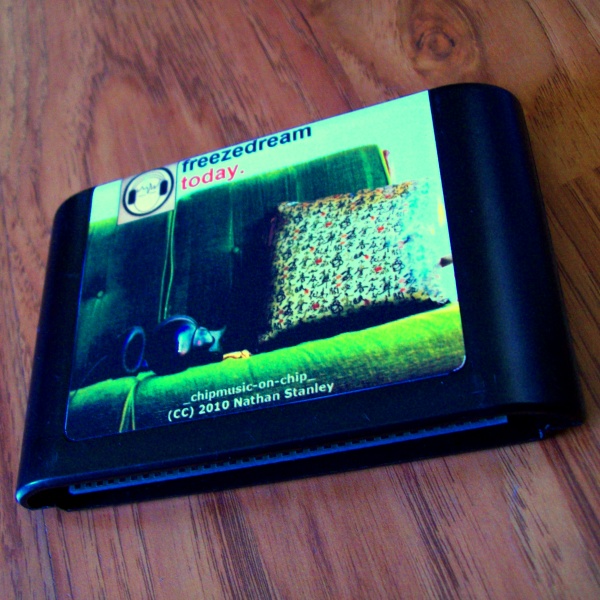
Review - "Today" (Freezedream)


How many chip music albums do you know of that have been released on an original cartridge? One of the very select few in existence happens to be Freezedream's "Today"--a mellow, ambient exploration of the limited 16-bit sound chip of the SEGA Genesis.

Using absolutely nothing outside of the Genesis' musical features, Freezedream has created an interesting and highly unique chiptune experience through nine brief tracks of IDM-style music. Though it may not be particularly impressive from a compositional standpoint, the release is nevertheless a rewarding and interesting one to listen to, taking into account Freezedream's interesting take on what a chip music album can be.

"Winter in July" opens up the album on a soothing and ambient note, while "Realtime Love" introduces listeners to more conventional chip music with distinct bass, melodic, and percussive layers rendered through the Mega Drive's scant six channels. "See You Next Tuesday" and "Cardioid" don't do the album any huge favors, but the atmospheric vibes of "Luer" and "Iridescence" succeed pretty well in creating a downbeat style of music that you wouldn't expect from the unusual hardware used.

"Today" is a short record, consisting of nine two-minute tracks; but that actually turns out to be for the best in the end. Freezedream's foray into the rarely-used sound chip of the SEGA Genesis won't revolutionize the way chiptunes are composed, but it does do a decent job of setting a dreamy and atmospheric tone that is too often missed in the modern chiptune scene.

SCORE: 7.5 out of 10 - "Good"

January 4, 2011

Review - "Rise of the Obsidian Interstellar" (Disasterpeace)


Over four years ago, Disasterpeace began writing a song called "Jump Error"--a song which, in due time, would be the first he would compose for a twelve-track, Nintendo NES and demoscene-style album that would mark a turning point in his continually evolving musical style.

Known in real life as Rich Vreeland, Disasterpeace has aimed for an uncommon style of chip music composition since he began writing his 8-bit tunes around 2005. "Level", his previous release, was a melodic and even symphonic kind of effort, that combined emulated tones with interesting canned drum samples as percussion, such as you'd hear coming from the Nintendo Entertainment System's WAV channel.

Rich's new album "Rise of the Obsidian Interstellar" continues that trend, but for this record, Disasterpeace has pursued a style more reminiscent of old demoscene music, with recognizable square and saw waves somewhat similar to the pleasant tunes of Radix and Cerror. The effort is a solid one, despite a couple mediocre melodies or slightly uncomfortable changes of pace from time to time.

"Prologue" quickly introduces us to Disasterpeace's latest musical journey, with an ethereal, staccato-based melody and slow drum beat, before launching into "Jump Error", a happy and catchy tune with a Radix-like feel and head-bobbing bassline. "Club Wolf", track number three, isn't the best of the record, with an occasionally dissonant melody; however, the intro is fun regardless.

"The New Formation", my personal favorite, is where things start to get really interesting. First comes a pleasant, recurring theme that sounds reminiscent of Martin Galway's filtered melodies of old, and then the tune launches into a nicely dancable bassline with a cool beat and enough style for its lengthy running time. "Beta's Brilliancy" begins as a soft, harmonic track that eventually grows louder and louder before--very cleverly--leading directly into "Ensis", a rather hard-driving track that, while opening well enough, soon gives way to a less-than-perfect melody and six-minute duration. Nevertheless, the track does recover for the final two minutes before giving way to "Day of Reflection": a soft, soothing melody that successfully provides a respite from the previous upbeat material.

In a few instances, Disasterpeace does resort to blending dissonant notes with his sometimes understated melodies--for a certain period--in both the ninth and tenth tracks. Still, he also treats his listeners to moments of melodic reward and pleasant themes that help the album remain a solid effort nevertheless. The penultimate track "Submerciful" has a nicely mellow feel to it, and "Constellations" ends the record with a mysterious lo-fi rendition of a theme that I'm pretty sure I've heard somewhere before.

Overall, "Rise of the Obsidian Interstellar" is a sufficiently rewarding, but not entirely flawless, chiptune experience, that thankfully manages to warrant more than a few listens with its solid selection of unique tunes. Several melodic hiccups and slightly awkward changes of pace do mar the experience somewhat, but Rich's remarkably high production values and demoscene-style musical cues ultimately win out in the end. If you're a Disasterpeace fan, you'll most likely be very pleased with this release; if you aren't, I would suggest checking out full preview tracks on the BandCamp page before deciding whether or not to make a purchase.

SCORE: 7.6 out of 10 - "Good"

December 13, 2010

Chetreo - "A Year of Change"


After months of promising demos, Chetreo's brand new EP "A Year of Change" is finally here. What you'll hear in this five-track release is a unique musical style centered on autotuned vocals and non-conventional GameBoy pop. It's also available completely free of charge, which makes it all the more worth picking up. Noteworthy tracks include the Zelda-inspired "The Boy Without a Fairy" and melancholy "All the Things We Did".

Download or stream the EP for free here: http://chetreo.bandcamp.com/album/a-year-of-change

December 8, 2010

4mat - "Starfields EP"


In advance of his upcoming sophomore chip album "Surrender", 4mat offers the new "Starfields EP", a three-track teaser release with two "live" recordings and one track from the new album.

Stream/download for free here: http://4mat.bandcamp.com/album/starfields-ep

December 2, 2010

Equinoxe - Evolution (8-Bit Girl)


Equinoxe's "Evolution (8-Bit Girl)" is an eight-track collection of what I'd like to call "easy-listening chip music". From the epic break-down beats of "1984" to the unique danceability of the cleverly-titled "His Name Was SID", this is truly not the kind of chiptune album you'll hear every day. Crafted with a variety of machines including the Commodore 64, Amiga and the good old-fashioned Nintendo NES, "Evolution" is an interesting, if not outstanding, departure from stereotypical GameBoy tunes. In fact, I didn't even see that particular handheld listed out of the many synthesizers that were used.

Below is an embedded preview of three tracks, including a remix of Rob Hubbard's C64 classic "Sanxion". You can download the full release here for 3.50£: http://www.equinoxestudios.co.uk/music/
Evolution (8Bit Girl) Album | Full songs by equinoxe_uk

November 22, 2010

Interview - Radix

He's arguably the biggest pioneer of module chip music, and if you haven't heard of him, you should reconsider your status as a chiptune fan. The artist in question is Radix, who spent several happy years of the 1990s composing legendary chiptunes on the Commodore Amiga. His carefree, intensely happy melodies would eventually earn him a fine reputation as one of the best chiptune composers of our time.

In real life, he's known as Jakob Svanholm, and he graciously took the time to answer several questions I had about chiptune projects from the past and future.

1. In the 1990s, you began writing module chip music... what introduced you
to the idea, and what led you there?

"Not entirely sure how I got started but I remember getting my hands on some chiptunes, and sitting down to study the techniques. One of the first chiptunes I listened to was Lost Scrotum by Paso. What a track :) I think I was immediately drawn to the simplicity of chip music, and to me they served as an outlet for all those naive melodies and pop elements I had growing inside my head, all this in a format which allowed me to get away with it :)

It's funny because I never considered myself a chiptune musician. I certainly composed my share of chiptunes back in the day, but it was mostly for giggles and not my primary objective in the demoscene. Looking back, perhaps it IS the chiptunes that made the biggest footprint, I don't know :)"

2. How did you get involved with the demoscene, and what was it like to be a
part of?

"I got involved in the demoscene during the peak of the BBS era in Sweden. Some demogroups around Stockholm were looking for members and I was asked to join. If I'd try to describe my impression of the demoscene, I'd say it was very friendly, it was exciting and underground, and finally I'd say it was very competitive, but in a positive way. I listened and studied the works of other musicians to no end, trying to improve."

3. Your compositional style in your chiptunes was quite unique for its time,
and is now heavily emulated by many other artists such as Malmen and Cerror.
What inspired you to create such happy, emotional melodies in this
particular way?

"In all fairness, everything is about emulating the work of others. You study, copy, reproduce. You mix up some ideas here and there and the result is something new. Speaking of those two fine musicians you mention, I think they're brilliant and they surpass me in the art of chip music in so many ways. The reason I made happy chiptunes, I don't know but I think that came naturally for me. Some chiptunes that inspired me greatly were happy, playful, charming and fun, and I believed there should be more tunes like that :) If I were to mention some maestros that taught me the ways of the chip, it would have to be Heatbeat, Monty, Supernao, Nuke, 4-mat, wotw, Reflex. Probably many more :)"

4. "Rainy Summerdays" and "Yoghurt Factory" are two of my favorite tracks of
yours. What were your goals while composing these tunes?

"Glad you like them :) Rainy Summerdays was composed on a rainy day in '95 on Amiga. Good times! '93-95 was the highlight of the demoscene for me. I think this particular tune was heavily inspired by a chiptune called "Spring Air" by Sire (one of the best chiptunes ever, in my opinion) used in the classic Lego 40k intro released at The Party 1993. Sire, if you read this, I tip my hat to you :)

Yoghurt Factory, well let's just say that the yoghurt factory in Alsace countryside actually exists, and they have all these clever machines doing all sorts of things :) I wanted to make a chiptune that was simple in melody but also had some interesting mechanical-moving-parts feeling going on at the same time."

5. Would you ever consider returning to chip tracking with a new album?

"Who knows, maybe one day :) When I listen to modern chiptunes, like the works of xyce, malmen, joule, zabutom, 4-mat, I can certainly feel this urge to get back to it. Though, right now I'm trying to focus on my Mosaik project as much as possible, and even that is down to a very casual level. That said, some collaboration work is not out of the question :)"

6. What do you want your legacy in the chip music scene to be?

"Someone once said that my music evokes feelings of limitless potential. Such a great comment, and if I can make one person feel that, then I'm already happy :)"